RETHINKING POPULISM | ARTICLES
30 August 2023
Tunisia’s 12th anniversary of the revolution is a reminder that Democratization needs more than elections. Periodic elections, a new constitution, licensed political parties and a freer press are part and parcel of the jigsaw puzzle of democracy. However, as the Tunisian example shows they are not enough for democratic sustainability. What if elections fail to fulfil the role intended for them to sustain democratization? That is, they are no longer sufficient on their own to deliver democratic, responsive, accountable and representative rule or development goals for the citizenry.
Perhaps students of Arab democratization have thus far given too short a shrift to the virtue of sustaining nascent democracies. This conundrum has pragmatic implications for understanding how fledgling democracies take the paths of sustainability or degeneration, especially in the form of power grabs by elected politicians and populist politics. Elections and constitutions may not safeguard a nascent democracy from degeneration. What can we learn from Tunisia’s democratization, especially since President Kais Saied’s July 25, 2021 self-coup, and its failure to eliminate barriers to power grabs and democratic reverses?
Introduction
(Some) Tunisians headed to the polls on January 29, 2023 for the second round of parliamentary elections. Shockingly low turnout (officially, 11.2%) 1 in the first round held on December 17, 2022, has rendered Tunisia ‘exceptional’ in a novel way. ‘This time, it is not the relatively (decade-long) enduring democratic transition that draws attention to the North African country, but the voter disinterest and disaffection so extreme that roughly 90% of Tunisians simply did not bother heading to the polls. The runoff elections recorded a similar voter turnout: only 11.3 percent of the country’s eight million voters, according to statistics released by the national election authority ISIE 2 (whose head was appointed by Saied). This casts in great doubt incumbent President Saied’s populist politics. Voters have sent a loud message of indifference, if not opposition, to the President’s lurching political pathway (masar) launched in his July 25, 2021 power grab. Saied’s contemptuous remarks that even 11% was superior to 99% participation in the (apparently) corrupt climate of past elections, has done little to imbue the anticlimactic results with the popular legitimacy they lack. Coming only months after meager participation in the July 25 referendum on the President’s singularly drafted constitution, Round 1 of the parliamentary election results have a dual impact. They entrench his demolition of the country’s nascent, albeit incomplete, democratic institutions fashioned after the 2011 revolution deposed dictator Ben Ali. At the same time, the lack of voter ‘buy-in’ to Saied’s populist political overhaul emits alarm bells. Whatever tenuous mandate the President claims seems to wear thinner by the day. The admittedly fragmented opposition, joined by increasingly vocal civil society groups from the UGTT to the Bar Association, has jumped on this embarrassment. Some (including protestors on this past January 14 anniversary of the revolution) have demanded Saied’s resignation, and most urged him to postpone or even cancel the 2nd round of elections. (He did not heed either call.) Critiques of burgeoning dictatorship in the country are at their sharpest and most diffuse since July 2021.
This article examines Tunisia’s December 17 legislative vote and its implications for the future of Tunisia’s democratization. In so doing, it reflects on the legitimacy of the vote and its implications for the country’s democratic process. That process was sustained for over ten years, presenting one of the most promising democratic transitions of the Arab Spring. Tunisia’s transition involved periodic elections and democratically elected parliaments (2011, 2014, 2019), two popularly elected presidents (2014, 2019) and a new constitution in 2014. The July 25, 2021 power grab by President Kais Saied reversed these democratic gains, hard-won over a decade. A year later, the July 25, 2022 referendum approved a new constitution. It aborted the processes and the legal frameworks that underpinned governance and the country’s democratization process since the adoption of the 2014 constitution. Yet civil and political societies in Tunisia are divided. The article thus addresses the 2022 parliamentary vote given its relevance for the future of political pluralism in Tunisia. The aim is twofold: 1) to identify the pitfalls of the elections for Tunisia’s democratic backsliding; 2) and to reflect on the challenges and outlook of democratization after the revolution.
Background: The Referendum
• The July 25, 2021 power grab by Kais Saied raised fears about the threat of the return of authoritarian rule in Tunisia.3 Most Tunisian political parties and civic bodies boycotted the July 25, 2022 referendum, for them a clear case of democratic breakdown and a return to authoritarianism.
• Low voter turnout in the referendum (officially 30.5%) suggested limited public support for (or indifference to) the new 2022 constitution.
• Even lower voter turnout in the first round of parliamentary elections (December 17, 2022) has firmed up this trend. Turnout was roughly the same, officially at 11.3%, in the second round on January 29 to fill 131 seats. Many in civil society view the figure to be inflated.
• Division runs deep after both the referendum and the parliamentary elections, both between pro and anti-Saied supporters, as well as among the opposition itself.
A feeble referendum campaign in the summer provided some clues about Saied’s (lack of) direction. Donning “Yes” t-shirts, in July enthusiastic volunteers gave mini-speeches into a loudspeaker when recruiting supporters for the referendum. They slapped stickers bearing a “Yes” with the green checkmark onto the hoods of beeping cars passing through. They handed out a pamphlet titled “the people establish,” al-sha’b yu’assis, a slogan underneath which was drawn a scale (presumably of justice, as in Saied’s presidential campaign). “We, the voices of Yes,” it explained, “seek through this new constitution to achieve justice and freedom and dignity.” These yes voters are “believers that real democracy will not succeed” except through a dual track between “political democracy” and “economic and political democracy,” according to the pamphlet. A “true balance” must exist between the three (judicial, legislative, and executive) powers in a “republican” system. All manner of issues ranging from public-private partnerships, distribution of national resources, and the Palestinian cause combine in what appeared intended to secure further support for the President’s constitution and his amorphous socio-political project.
Unfettered Presidential Powers in the new Constitution of 2022
Tunisia’s new constitution has on paper created two chambers (the National Council of Regions and Districts (NCRD) & the People’s Representative Assembly), expanding popular input into the decision-making process. The December 17 and January 29 votes were for the People’s Representative Assembly, to which individuals (and not parties) were elected. The regions will in theory be more included in decisions about budgets, and developments. In practice, regions with legislative powers in the NCRD with have no independent source of revenue. This defeats the purpose of a key reform designed to institute decentralization.
• The new constitution effectively nullifies the planned constitutional court. This was stipulated in Article 101 of the 2014 constitution. The president still rules without judicial oversight and review.
• These developments do not bode well for democratic sustainability. The removal of Article 88 of the 2014 constitution illustrates this, as the powers invested in the legislature in the old constitution no longer apply. Removal of Article 88 gives the president a field day in exercising unfettered powers. Article 88 reads: “The Assembly of the Representatives of the People may, through the initiative of a majority of its members, present a motion to bring to an end the President of the Republic’s term for a grave violation of the Constitution. Such a motion must be approved by two-thirds of the members. In such an event, the matter is referred to the Constitutional Court for a decision by a majority of two-thirds of its members.”
• Worse, Article 116 in the new constitution empowers the president to dissolve both -legislative houses; whilst Article 61 gives powers to revoke parliamentarians’ mandates.
• Article 96 now gives the president powers, without recourse to a constitutional court, to declare a “state of exception”, an issue at the heart of how the whole July 25 power grab came about. President Saied used Article 80 of the 2014 constitution to declare a state of exception and dismiss the government and parliament.
Of Populisms and Opposition
Before the referendum, Tunisia’s oft-lauded democratization began its U-turn on the President’s grab last July 25, 2021. Two trends are visible since the July and December 2022 elections:
First, are the populist politics and discourse undergirding Saied’s presidentialism as well as support for the man supporters view as a kind of savior from failed policies under consecutive governments.4 For three decades, postcolonial Tunisia was headed by President Habib Bourguiba. Like fellow Arab leaders,5 Bourguiba was known for his demagoguery. There is a thin line between populists and demagogues. Bourguiba was literally a self-styled political demi-god, appealing to the multitude through his superior oratory skills. He knew how to win the masses over by constantly appealing to people’s affect about liberation from colonialism, a fight in which he played a major role. Saied lacks Bourguiba’s historical legitimacy. His populism is an amalgam of two elements: 1) bias against the political elite in its entirety, and 2) emotional rhetoric that was able to drum up sufficient public hostility against the Islamist Ennahda party and the Mechichi government. That public support enabled him to engineer his self-coup on July 25, 2021. That support has decreased markedly mostly due to Saied’s failure, economic and political. As mentioned above, the 2022 election’s voter turnout was the lowest ever in the history of Tunisia’s elections. Tunisians did shirk voting as a sign of disaffection with all politics.
Rallying enormous crowds, orating interminable speeches, and speaking to Tunisians directly in periodic radio programs, the first President was a cunning but self-absorbed dictator who created and encouraged a cult of ‘Bourguibism’ centered around him.6 Its hallmarks were a project that carried Tunisia towards progress, (secularizing) modernization, and state-building. He often spoke of “the Tunisian nation” (al-ummah al-Tunisiyyah), of which he saw himself as the architect and patriarch. Unseating Bourguiba in a bloodless coup in 1987, Ben Ali was much less charismatic and never filled his predecessor’s shoes in his public presence, in his ability to mobilize the masses. Since the Tunisian revolution of 2011, the political scene has exploded with a plurality of forces and voices. Populisms (in the plural) have been one characteristic of political discourses and counter-discourses, many inflected with contestations over identity (e.g. Islamist vs. secularist). Nidaa Tounes (former President Beji Caid Sebssi’s party), Ennahda, Abir Moussi’s Free Destour Party, are all examples of parties to various degrees engaging in populist rhetoric of their own.
Yet Kais Saied’s clarion populist call has been perhaps the loudest. As a dark horse candidate, his 2019 campaign slogan was the revolutionary chant ‘The people want,’ al-sha’b yureed. His revolutionary variant of populism helped win him the great popularity that catapulted Saied to the presidency despite his scant political experience. Defender of the revolution, of marginalized and disempowered youth, of the masses, robbed by corrupt elites: this has been Saied’s framing of his initially ambiguous political program since the beginning. The qualitative difference among Tunisia’s various populist discourses, of course, is that Saied is now the supreme power-holder in the country, after having usurped constitutional institutions in July 2021. Still, as we comment below, his populism in the name of the revolutionary ‘people’s will’ seems to wane in effectiveness as his new constitution and parliamentary elections have flopped.
To gauge the populism of Saied and his supporters, newspaper headlines from the last few months are telling. “The people choose the third republic,” declared the front page of Alchourouk the day after the referendum.7 Indicating the personalized slant such approbation takes, the same newspaper basked in the glory of the President’s victory: “Trust in the President Decided the Results.” 8 In his turn, Saied “accused ‘players’ working on failing the referendum.” 9 This added to an atmosphere of hatred against the post-2011 political establishment. Ennahda in particular is the target of much of this hostility. The term “black decade” al-‘ashriyyah al-sawdaa’ to refer to Ennahda’s role in the ten years after the Tunisian Revolution, is widely used, 10 not just by Saied supporters or Abir Moussi’s Free Destour Party, arch-rival of Ennahda. Opposition voices such as Citizens Against the Coup and the National Salvation Front who claim Saied to be authoritarian are more accommodating. This earns them much flak by some more rigidly anti-Islamist oppositionists such as Communist Hamma Hammami, member of another anti-Saied coalition of five left- or socialist-leaning parties.
The second trend, working in Saied’s slight favor, is the relative weakness and lack of inventiveness by Tunisia’s civil society.
Citizens Against the Coup or the Salvation Front are neither parties nor political coalitions. They suffer from many weaknesses, including a lack of a clear vision or alternative political program around which Tunisians can rally in concerted action against the president. Their attempts to occupy some sort of anti-authoritarian, pro-democratic space have thus far yielded limited impact other than media attention. Even their protests staged in the days before the referendum 11 failed to draw overwhelming crowds. Two that we attended mustered no more than hundreds each. The Citizens/Salvation protest featured a more celebratory atmosphere. The demonstration was replete with waving Tunisian flags, impassioned speeches, etc.
The UGTT, formed in the 1920s and then created in 1946 has a huge following. This gives it much political weight when bargaining for wage increases, 12 etc. In 2022, the union finally come to an agreement on economic reforms that would presumably pave the way for an IMF deal. Part of the agreement is a 5% wage increase for public and civil servants to offset mounting inflation (nearly 9%).13 By June 2022, the powerful union even challenged President Saied’s plans for the new constitution and unilateral political management.14 Until very recently, the union’s position remained ambiguous, even as it has pointed out problems with the President’s new constitution and his chokehold on power. In the aftermath of the referendum in July, one view from the UGTT bordered on critical while seeming to praise a rupture with the post-2011 establishment, something Saied is often praised for by supporters: the referendum is “breaking with the previous [post-2011 political] system” but suffers from an “absence of the youth.”15
The UGTT insists on its role as a heavyweight political player. Despite its criticisms against him over the past year and even its general strike on June 16, 2022, the President has not gone after them on corruption or other charges. Vacillating between criticism of the President while avoiding total confrontation, the union remained ambiguous for months on the July 25th ‘pathway.’ Since the parliamentary elections, however, the Union’s Secretary General Noureddine Tabboubi has become more scathing of Saied, noting that Tunisians have expressed their refusal by abstaining from elections. “We are not afraid of prisons,” he declared, recalling the Union’s historical boldness in opposing dictators. His calls to a UGTT-led national dialogue have resumed.16 As widely expected, the new “26 January Salvation Initiative” has commenced in conjunction with the Tunisian Human Rights League, the Bar Association, and the Tunisian Forum for Economic and Social Rights (FTDES is the French acronym).17 The conditions of such a dialogue—revived and adapted from the pre-July 25th, 2021 political impasse—remain murky. For instance, will (de-parliamentarized) political parties be invited to participate? Will the President, who has rebuffed all calls for dialogue even before his power grab, agree to sit at the negotiating table with forces opposed to his political project? The latter is doubtful. One thing is clear. Key civil society and political players seem keen on heading or supporting such initiatives if partly to stake a claim in the political game that is in great disarray.
One pattern confirmed in a visit to Tunis in July-August, as well as conversations with Tunisians since the December elections, is that across the political spectrum, Tunisia’s political elites are overwhelmingly against Saied.18 (Harakat Al-Cha’b, one of the lone parties supporting Saied, voices increasing criticisms of the President.). In a summer interview, the elder Chebbi, head of the Salvation Front opposing Saied, could muster no new ideas about the anti-coup crowd’s next steps.19 His calls to hold early presidential elections 20 read almost as an early self-nomination for the high office.
Statements such as Hamma Hamami’s invocation of foreign conspiracies (“Saied allied with the UAE and Egypt and Saudi Arabia axis”) 21 did not really show Tunisians out of their predicament. Since then, the parliamentary vote set in motion a flurry of initiatives (mubadarat) by various opposition politicians and parties, civil society activists, and even law professors.22 How much overlap can take shape by these proposals is an open question. Still, the President’s resorting to what the Tunisian opposition refers to as sham political prosecutions. These have included, for instance, Ennahda’s Ali Laraayedh who is now in prison on allegations of bearing responsibility for the travel of Tunisian fighters to Syria whilst he was Prime Minister (2013-2014). Rachid Ghannouchi, House Speaker of the dissolved parliament, and one of Saied’s most vociferous critics, has been repeatedly dragged through court cases but without any sentencing so far. Another example is that of human rights activist and former minister Ayyashi Hammami under the ‘fake news’ Decree 54 and Chaimaa Issa for insulting the President.23 This reportedly took up Abir Moussi’s lawsuit against other members of the Salvation Front on terrorism-related charges, which has the effect of mobilizing more, not less, opposition. It is true that Arab dictators’ ‘learning’ has increasingly encroached upon the freedom of speech, gagging journalists and activists through intimidation and financial pressure. It is somewhat of an oversimplification to regard all Arab media as “co-opted,” 24 however, overlooking the struggles of Tunisian journalists who challenge President Saied. For instance, the Tunisian Journalists’ Syndicate has repudiated Decree 54 (the President’s ‘fake news’ law),25 and criticized the state’s treatment of journalists during the elections.
Democratization after Revolution
Tunisia went through ten years of sustained democratic contests and processes but without much protection of its 2011 revolution. There is no doubt that what undermined the “promise” of such an experiment was the 25th of July power grab by President Kaies Saied. Chiefly, whether Tunisians root for Saied or oppose him, the power grab has divided 26 political and civil societies and citizens. Despite mounting opposition, not enough Tunisians seem to be able to transcend antipathy towards the post-2011 elite (Ennahda in particular) to actively oppose the president. Tunisia’s political elites despite ten years of democratic institution-building remained election-obsessed to the detriment of “shadow government”, “government-in-waiting” or opposition. This left Tunisia unprepared for the snares of democratic reverses and the reemergence of authoritarian rule. The “false climax” of Tunisia’s democratization strangely echoes the foretaste of how democratization unsupported by strong opposition will always atrophy.
How on earth has Tunisia grown so quickly over eleven years disaffected with its own fledgling democratization and much-celebrated 2014 constitution?
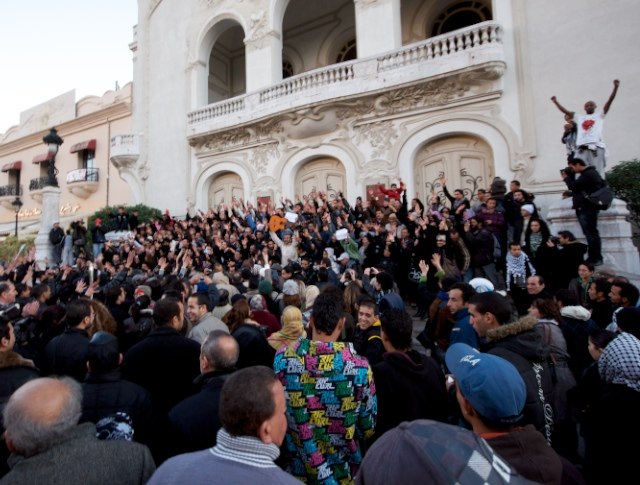
Demonstrators on the steps of the Municipal Theatre, Avenue Bourguiba, Central Tunis, January 2011. Wikimedia Commons – credit Chris Belsten
Twelve years ago this month, the surge of ‘the people’ was the emblem of an Arab world caught in the vortex of cascading changes via public square uprisings. It was the most compelling sign of emerging politics in the region, heralding democratic promise. The transitions that gripped most of North Africa (Tunisia, then Egypt followed by Libya) travelled further afield to Syria and Yemen. The period stretching from the October 2011 Constituent Assembly elections in Tunisia and reaching Egypt and Libya and ending in the 2019 Tunisian parliamentary elections modestly tempted usage of the label “democratic”. For, these transitions ushered in democratic openings, but not democracy. Here lies the most challenging question: why? Fast-forwarding the discussion from October 2011 elections to the July power grab by President Kais Saied one begins to grasp, at least tentatively, another puzzle: the failure of Tunisia’s political parties, elites and civil society to protect the democratic milestones/gains. Specifically, the 2014 constitution which took nearly three years of deliberation and consultation proved to be insufficient to self-preserve, much less guard against a return to the pre-January 14 brand of autocratic rule.
In Tunisia, the pitfalls of such stumbling have fed into Saied’s attack on democracy from within, now more or less institutionalized in his new constitution. It is true that Tunisia’s post-2011 power-holders changed little or nothing in the economic management of the state, which remains bogged in dependency. As a consequence, extending voting and participatory rights to formerly excluded citizens entrenched contestation over power without tangible socio-economic benefits. Unfortunately, for those who pinned high hopes on his “corrective” moves, Saied is not living up to his promises to stanch corruption, redistribute wealth, or ensure ‘real’ representation for the people. He performs no better than the politicians and parties of the decade before him. His economic program has not departed from the pursuit of millions in international aid. A bitter pill for many, the new and desperately needed IMF loan of $1.9 billion, remains uncertain with talks delayed once again.27 The credit rating agency Moody’s has just downgraded Tunisia to “Caa2 with a negative outlook,” warning that the country is perilously close to bankruptcy.28 Unemployment has not budged, fomenting protests just days after the referendum and since, for instance by unemployed university graduates demanding jobs of the President.29
In the post-election momentum, a large anti-Saied protest took place on January 14, 2023. Meanwhile, inflation is on the rise, and a widely unpopular new tax snuck into the 2023 budget rankles Tunisians far and wide. Poor populist showmanship, such as Saied’s visit to a small corner market (hanut) to purchase gleaming bottles of pre-arranged olive oil,30 is presumably meant to reassure the watching public that talk of empty store shelves is rumor-mongering circulated by the President’s enemies. Yet these choreographed scenes do not relax the pinch of steep prices, or magically make milk, sugar, oil, and other commodities in short supply suddenly available. (Truckloads of Libyan aid in the form of sugar, oil, and flour generated disbelief among many Tunisians that their country—or Saied, according to the opposition–was now soliciting handouts from neighbors.31)
‘Tunisians can summon the stamina to marshal all possible resources—political, civic, creative, and value-based—to wrest back the democratic significance of the mantra The people want. The struggle for democracy is theirs for the long haul.’
Always easy populist fodder in the Arab world, “sovereignty” has been another of the President’s axe to grind with international powers,32 accused of meddling in election season or paying off the opposition. After the December election, the president’s speech in front of national security officials 33 reverted to familiar conspiratorial rhetoric. Saied constructed a confusing plot linking everything from price-fixing cartels to threats against him to the tragic, anger-rousing sinking of a migrant death-boat (harqah) in Zerzis, inhumanely handled by officials who secretly buried bodies at random. His familiar name-calling of all those who oppose him as ‘traitors’ bankrolled by ominous foreign powers has come to fall flat. The speech is cause for mockery among many. Tunisians are more astute than Saied’s performances appear to acknowledge.
Conclusion: The Coming Fall of Saied?
Certainly, Tunisians do not await the restoration of their democracy by Western powers, whether the US or the EU. A photograph of Saied and the First Lady with Nancy Pelosi was repudiated by Saied’s critics as an image signaling international legitimacy bestowed upon the President. But his visit to Washington DC for the US-Africa Summit in December 2022 was largely uneventful. The US Department of State’s (qualified) statement that the December 17 elections “represent an initial step toward restoring the country’s democratic trajectory,” was disheartening to some of Saied’s opponents.34 As ever, untying the knot of democratic backsliding falls on the shoulders of Tunisians themselves, their mobilization of a formidable agency.
Protests on January 14, the anniversary of the revolution, were more symbolic than practically effective in dislodging the President’s institutional overhaul. Yet vocal dissent is significant for keeping alive the democratic dream, endangered not just in Tunisia but as is by now well-recognized, established Western democracies and ‘Third Wave’ democratizers. Politics of ‘the street’ (al-shari’) can be notoriously unreliable, given to cooptation by less-than-democratically minded protestors. Examples from the January 6, 2021 insurrection in the US, or Bolsonaro supporters’ recent rampage in the Brazilian capital on January 8, 2022,35 point to the potential perils of emotive politics expressed in popular protest against democratic institutions. Combined with new and creative methods such as civil disobedience (led perhaps by Tunisia’s capable civil society leaders such as the Nobel Quartet), protest is one invaluable ‘pressure point’ for democratically-minded Tunisians, from political elites to ordinary voters. Twelve years after revolutionaries forced a reviled dictator’s departure, the flame of moral protest should not be discounted. The boycott of both rounds of elections is bad news for Saied’s future in power, but perhaps will embolden opposition and revive the democratic process. Opposition parties have already declared they will not recognize the newly elected Parliament. Beset by failure, socio-political unrest, economic strife, and increasing opposition to his rule, President Saied may be faced with impending doom.
Tunisians can summon the stamina to marshal all possible resources—political, civic, creative, and value-based—to wrest back the democratic significance of the mantra The people want. The struggle for democracy is theirs for the long haul.
Notes
- Amara, Tarek. Reuters. “Runoffs due in most Tunisian districts in election marked by low turnout,” December 20, 2022, https://www.reuters.com/world/africa/runoffs-due-most-tunisian-districts-controversial-parliament-election-2022-12-19/
- Mosaique FM, January 29, 2013, http://bit.ly/3WSo4Fs
- Larbi Sadiki & Layla Saleh, “Tunisia’s Presidential Power-grab is a Test to its Democracy.” openDemocracy, 28 July 2021: https://www.opendemocracy.net/en/north-africa-west-asia/tunisias-presidential-power-grab-is-a-test-for-its-democracy/ [Retrieved: 28 September 2022]
- Larbi Sadiki, “The 25th of July: Tunisia’s Revolution Part 2?” 30 July 2021, Al-Jazeera English: https://www.aljazeera.com/opinions/2021/7/30/the-25th-of-july-tunisias-revolution-part [Retrieved: 25 September 2022]
- Some classify Arab regimes as on the whole ‘authoritarian populist’. See for instance Raymond Hinnebusch. 2006. “Authoritarian Persistence, Democratization Theory and the Middle East: An Overview and Critique.” Democratization 13(3): 373-395
- See, for instance, Brown, L. Carl. 2001. “Bourguiba and Bourguibism Reconsidered: Reflections and Interpretation,” The Middle East Journal, 55(1): 43-57.
- Alchourouk, July 26, 2022
- Alchourouk, July 27, 2022
- Al-Maghreb, July 24, 2022
- Assabah, July 22, 2022
- Last-minute protests were reported in Tunisian newspapers, for instance, Al-Maghrib, July 21, 2022
- Economic Intelligence Unit, “Union Power in Tunisia,” 18 December 2015: http://country.eiu.com/article.aspx?articleid=1103789294 [Retrieved: 25 September 2022]
- Africa News, “Tunisia: Government reaches pay deal with key union.” 16 September 2022: https://www.africanews.com/2022/09/16/tunisia-govt-reaches-pay-deal-with-key-union// [Retrieved: 23 September 2022]
- Alessandra Bajec, “ How Tunisia’s trade unions became Kais Saied’s most powerful opponent,” Al-Arab Al-Jadid, 28 June 2022: https://english.alaraby.co.uk/analysis/how-tunisias-trade-unions-are-challenging-kais-saieds-rule [Retrieved: 24 September 2022]
- Al-Sha’b, July 28, 2022
- Almaghreb, Dec. 22, 2022, https://bit.ly/3X5V128
- Shems FM, January 27, 2023, http://bit.ly/3JuRPce
- Interviews with Ennahda and leftist politicians and civil society activists, July 2022
- Almaghreb, August 3, 2022, p. 4
- Almaghreb, January 29, 2023, http://bit.ly/3YpnTTt
- As reported in the newspaper 24-24 on July 22, 2022
- For instance, Sghaier Zakraoui on Mosaique FM’s Midi Show, January 10, 2023, https://www.youtube.com/watch?v=PlXrxAjYTq4&t=530s
- Tarek Amara and Angus Mcdowall, “Tunisian Activists Decry Intimidation as Vote Looms,” Reuters, January 27, 2023, http://bit.ly/3Hh5Iby
- The Economist, “The Arab World’s Rulers Have Turned Journalists into Courtiers,” January 13, 2023, http://bit.ly/3wCU2e9
- Middle East Monitor, “Tunisia: Journalists’ Union Says Country is Turning into a Prison,” January 11, 2023, http://bit.ly/3XNtkvt
- Where do we head in light of Tunisian’s divisions?” wondered the front page of Al-Maghreb, July 27, 2022.
- Middle East Monitor, “Tunisia: Financial crisis will worsen if no IMF deal is made,” January 5, 2023, https://bit.ly/3Xkl0Th
- Moody’s, 2023, “Rating Action: Moody’s Downgrades Tunisia’s Ratings to Caa2 with a Negative Outlook, Concluding its Review,” January 27, http://bit.ly/3HF3tzW
- Assabah, August 3, 2022
- Presidence Tunisie Facebook page, January 1, 2023, https://www.facebook.com/watch/?v=5634818653313527&t=1
- See for instance Al-Quds Al-Arabi, January 17, 2023, http://bit.ly/3RidFC0
- وليد التليلي، “جدل السيادة التونسية مجددا”, العربي الجديد، August 1, 2022, https://bit.ly/3QijXiC
- Presidence Tunisie Facebook Page, December 28, 2022, https://www.facebook.com/watch/?v=1212894952990110&t=953
- US Department of State, “Tunisian Parliamentary Elections,” Dec. 18, 2022, https://www.state.gov/tunisian-parliamentary-elections/
- AP, ‘No Amnesty!’ Brazilian protests demand jail for rioters,’ Jan. 10, 2013, https://apnews.com/article/jair-bolsonaro-politics-brazil-government-democracy-b62784248fee194c650df5c1da0fd120 [Retrieved: 11 January 2023]

This article is published under a Creative Commons Attribution-NonCommercial 4.0 International licence.
 Rethinking populism