
How institutional complacency enables a neo-Nazi comeback
22 July 2026
Elon Musk, the owner of X commented with only four words – “This is messed up” – on a post by Rebecca Mistereggen, a Norwegian right-wing activist associated with Document.no, one of the country’s right-wing alternative-media outlets.
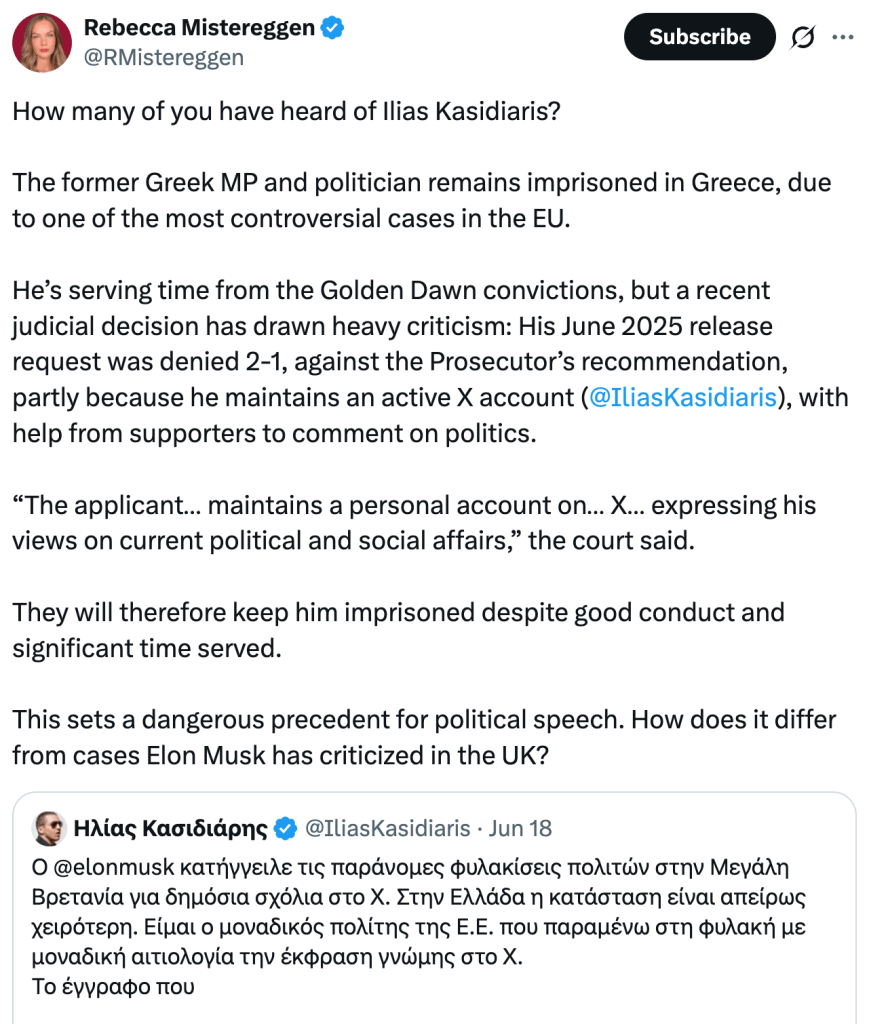
Mistereggen presented Ilias Kasidiaris – a former leading figure of the neo-Nazi Golden Dawn who was convicted of directing a criminal organisation in Greece – as a victim of political persecution: a prisoner who had behaved well, had become eligible for conditional release and was allegedly being kept behind bars partly because he continued to express political opinions online.
The formulation concealed more than it revealed. Golden Dawn was not merely a radical political party whose members occasionally committed unrelated crimes. In March 2026, a five-member appeals court unanimously upheld the 2020 judgment that it had operated as a criminal organisation. The court confirmed Kasidiaris’s conviction for directing that organisation, while also upholding convictions connected with the murder of Pavlos Fyssas, the attempted murder of Egyptian fishermen and other violent attacks.
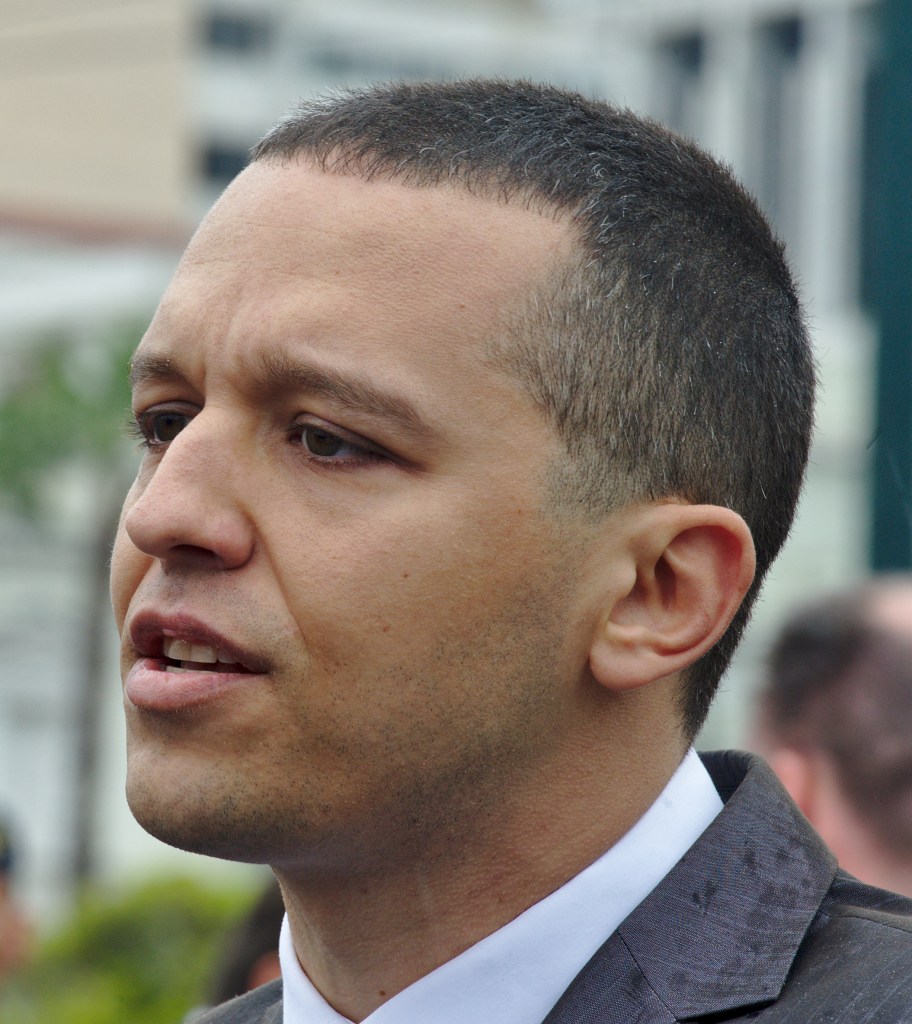
By DTRocks – Own work, CC BY-SA 4.0, https://commons.wikimedia.org/w/index.php?curid=90603413
Musk’s intervention contained no argument, legal reasoning or indication that he had examined the case. Yet within hours his casual – and evidently poorly informed, if not politically predisposed – reaction had been transformed by Kasidiaris into something much grander: a forceful international denunciation of his “illegal detention” by what he called “the most prominent personality in the world.” In the conspiratorial universe Kasidiaris constructs and invites his followers to inhabit, the supposed international vindication was immediately followed by the predictable claim that Prime Minister Kyriakos Mitsotakis had ordered the media to suppress the news. Musk’s four-word reaction had become, through rhetorical inflation, both a global intervention and evidence of a domestic cover-up.
The episode offers a near-perfect illustration of Kasidiaris’s political method. An ambiguous and lukewarm social-media reaction becomes international vindication. Limited media attention becomes proof of censorship. A convicted director of a violent criminal organisation becomes a political prisoner, or a “hostage,” as he increasingly prefers to describe himself. Imprisonment ceases to signify culpability and becomes instead the defining evidence of patriotic sacrifice.
This is an example of what Barton Hronešová and Kreiss call “hijacked victimhood”: a political strategy that reverses the relationship between perpetrator and victim, recasting actors associated with domination or violence as the injured party and presenting those who hold them accountable as the true aggressors. The reversal establishes a new moral order. Kasidiaris is no longer required to answer for Golden Dawn’s violence; the state must answer for what it has allegedly done to him. His supporters are similarly repositioned, not as adherents of an authoritarian and racist political project, but as an oppressed national community deprived of its authentic representative.
The prison is especially valuable to this performance. It supplies the material setting through which defeat can be converted into endurance, marginalisation into distinction and criminal conviction into political martyrdom. Research on populist memory politics has shown how the performance of victimhood enables political actors to preserve the illusion that they remain embattled outsiders even when they possess considerable organisational power or public visibility. By inserting himself into a historical succession extending from the classical Athenian politician Themistocles to the Greek war of independence from the Ottoman Empire, Kolokotronis, Kasidiaris similarly removes his conviction from its specific legal and historical context and incorporates it into a timeless national story of persecuted patriots.
Conspiratorial reasoning completes the transformation. Conspiracy narratives are particularly useful to populist movements because they encourage the prior rejection of established epistemic authorities. Courts, journalists and public institutions cease to be potentially fallible sources whose claims must be evaluated; they become components of the conspiracy itself. Contrary evidence can therefore be dismissed as fabrication, while the absence of confirming evidence becomes proof that the cover-up is working. As Keith Raymond Harris argues, the rejection of epistemic authority helps insulate populist political programmes from criticism while giving followers the sensation that they are reclaiming an autonomy denied to them by hostile elites.
The facts therefore need to be stated clearly. Kasidiaris is not serving a prison sentence because he posted political opinions on X. He was convicted of directing Golden Dawn’s criminal organisation, and that conviction was unanimously upheld on appeal in March 2026.
This does not mean that the circumstances surrounding his applications for conditional release should be exempt from scrutiny. In June 2025, a prosecutor recommended that Kasidiaris be released under restrictions, reportedly taking into account the proportion of his sentence already served and his acquittal in the criminal proceedings concerning the Spartans. The Judicial Council in Lamia nevertheless rejected the application the following month by a two-to-one majority. The precise reasoning employed in that and other parole decisions can, and in a democratic legal order, should, be examined independently and rigorously. The rights of prisoners do not cease to exist because their politics are repellent.
But scrutiny of a conditional-release decision is not the same as accepting Kasidiaris’s central falsehood: that he is imprisoned for speech rather than for directing a criminal organisation. During the appeal proceedings, he sought to distance himself from what he called criminal acts committed by Golden Dawn supporters while continuing to deny personal responsibility for the organisation’s crimes. What remains strikingly absent from his current political self-presentation is any serious acknowledgment of the organisation he helped lead, the violence carried out in its name or his own responsibility for the political and organisational environment within which that violence occurred.
Yet simply correcting these falsehoods misses the more important political question. Kasidiaris does not need his account to withstand rigorous legal or historical examination. He needs it to resonate emotionally with citizens who already suspect that institutions conceal more than they reveal, that justice is applied selectively and that political power protects its own. The pertinent question, therefore, is not merely why his account is false. It is why, under present conditions, it can nevertheless sound plausible.
From scandal to “the System”
Kasidiaris does not invent every grievance to which he attaches himself. He works with materials already present in Greek public life: a surveillance scandal that shook Greek political life, media dependence, the atrocious handling of the Tempi railway disaster, the OPEKEPE scandals involving misappropriation of EU funds, constitutional and parliamentary immunity arrangements that have impeded or delayed investigations involving ministers and MPs, delays in justice and the widespread suspicion that accountability operates differently for those close to power.
The OPEKEPE affair is not a fantasy. On 16 July, the European Public Prosecutor’s Office indicted four serving Greek parliamentarians among twenty-two defendants in its investigation of alleged agricultural-subsidy fraud. The scandal had already produced ministerial resignations and parliamentary investigations that Reuters described as inconclusive.
Nor are concerns about institutional performance confined to opposition rhetoric. The European Commission’s 2026 Rule of Law Report presents a mixed picture, recording reforms and some real progress. But it also states that the number of prosecutions and final judgments in high-level corruption cases remains low; that concerns persist over the political independence of public-service media; that ministerial immunity continues to create institutional difficulties for prosecutors; and that frequent legislative changes weaken legal certainty. Judicial scrutiny of aspects of the spyware affair also remains incomplete.
These are not signs that Greece has ceased to be a democracy. They are signs of a democracy whose mediating institutions are frequently experienced as slow, selective, opaque or subordinated to executive convenience. The distinction is important to keep in mind. Apocalyptic diagnoses help Kasidiaris. Complacent denials help him too.
The resulting crisis of credibility is measurable. According to the OECD’s 2026 survey, the proportion of Greeks expressing high or moderately high trust in the national government declined from 32 per cent in 2023 to 24 per cent in 2025. Trust was only 17 per cent among younger citizens, 39 per cent for the courts and 15 per cent for political parties.
Such figures do not show support for fascism. They reveal the political terrain on which fascist and ultranationalist narratives can operate. Populism begins by translating diffuse unease into a specific crisis. Disappointment, insecurity and anger do not speak politically for themselves. They have to be organised into a story. Kasidiaris offers one: Greece is governed by a corrupt and anti-national “System”; the institutions that claim to regulate political life are merely its instruments; migrants are invading the country stealthily replacing the population and altering Greece’s cultural makeup; political elites enrich themselves while persecuting patriots; and every attempt to restrict him proves how much those elites fear the authentic will of the Greek people.
This story is effective precisely because it oversimplifies a complex reality and joins verifiable failures to extravagant conclusions. OPEKEPE becomes evidence that the governing party is itself a “criminal organisation.” Questions surrounding parole become proof that Kasidiaris is imprisoned solely for expressing an opinion or maintaining a social media presence. Media caution becomes an order from the prime minister’s office. Judicial rulings become the work of party agents. Migration policy is coupled with the Great Replacement Theory and becomes a plan for the racial replacement or degradation of the nation.
Once these elements are fused, contradiction no longer damages the narrative – as a matter of fact it strengthens it. Evidence against Kasidiaris comes from institutions controlled by “the System.” The absence of evidence demonstrates the effectiveness of the cover-up. Silence proves censorship; criticism proves fear; prosecution proves political persecution.
The manufacture of a patriotic martyr
Kasidiaris also embeds his personal story within a highly selective national genealogy. He moves effortlessly from figures in Greece’s national mythology – Themistocles to Kolokotronis – and then to himself: those who fight honestly for Greece, he tells his followers, have always been imprisoned, exiled or murdered. His incarceration is thus lifted out of its specific judicial context and inserted into a timeless history of patriotic martyrdom.
This is more than historical kitsch. It performs a political cleansing. The violence of Golden Dawn disappears. The attacks on migrants and political opponents recede from view. In their place stands the solitary patriot, punished by a corrupt regime because he refuses to surrender.
His prison narratives serve the same function. Searches of his cell, restrictions on telephone communication and rejected parole applications are described not as aspects of imprisonment to be evaluated according to law, but as episodes in a heroic confrontation between the captive nationalist and an anxious state. The prison becomes a stage on which masculinity, endurance and national authenticity are continuously performed.
Yet Kasidiaris’s presentation is not always solemn. It is mixed with jokes, insults, memes, hashtags and promises that a DJ will play only Notis Sfakianakis (a well-known singer who has openly expressed support for the neo-Nazi Golden Dawn) at his political gathering. This informality is politically significant. It domesticates extremism. The language of racial exclusion and national purification is presented alongside banter, popular music and the cheerful self-confidence of an online celebrity. The former Golden Dawn leader no longer appears only in black-shirted formations. He appears as an accessible, persecuted and mischievous outsider who laughs at the panic of the powerful. This is platform fascism adapted to an age in which irony and aggression, entertainment and ideological radicalisation, circulate together.
Democratic self-defence is not enough
None of this places Mitsotakis and Kasidiaris on the same political or moral plane. Mitsotakis leads an elected centre-right government. Kasidiaris was a leading figure in a neo-Nazi organisation judicially confirmed as a criminal organisation. To collapse the distinction would reproduce the very anti-institutional cynicism on which Kasidiaris depends.
Nor is the government responsible for every racist or authoritarian disposition in Greek society. Golden Dawn emerged from longer histories of ultranationalism, anti-communism, racism, political violence and state tolerance of the extreme right. Its rise during the financial crisis preceded the present government.
But the government is not an innocent observer of the conditions in which Kasidiaris’s politics regain plausibility. There is a discernible hubris in its manner of governing: a confidence that electoral victory, technocratic authority and control of political communication entitle it to brush aside criticism rather than answer it. Public concerns are too often treated as misunderstandings to be corrected, exaggerations to be dismissed or irritants to be managed. Criticism is met with denial, deflection or appeals to stability, while social sensitivities are acknowledged only when they become electorally costly.
This is more than a problem of tone. A government that appears unwilling to listen gradually weakens the democratic authority of its own explanations. When citizens encounter opacity, delayed accountability or institutional defensiveness, the repeated insistence that everything is proceeding properly ceases to reassure. It begins instead to sound like evidence of detachment from the society being governed.
The government’s responsibility therefore lies not simply in its failure to prevent the growth of extremist narratives, but in a political practice that helps create an audience for them. It governs as though contested economic performance, electoral predominance and communicative discipline can substitute indefinitely for institutional credibility. It approaches scandals as episodes to be contained rather than ruptures demanding transparent investigation and political accountability. It allows Parliament to appear too often as a defensive perimeter around the executive, and justice as a process so slow, selective and uneven that its eventual conclusions struggle to command confidence.
The hubris lies partly in the assumption that public dissatisfaction can always be managed from above: that anger will dissipate, memories will fade and each new controversy will displace the previous one. But citizens do not experience scandals as isolated episodes. They accumulate them into a broader judgement about how power is exercised, whose voices are heard and whether those who govern are ever required to answer convincingly for their actions.
Mitsotakis himself has proposed constitutional changes to ministerial immunity as part of an effort to restore public trust, a recognition that the existing architecture has become politically unsustainable. But constitutional revision cannot substitute for a change in governing practice. Institutions cannot recover credibility while criticism continues to be treated as hostility, accountability as a concession and public unease as a communications problem.
A democracy has the right to defend itself against organisations that use electoral politics to facilitate violence and dismantle democratic freedoms. Legal exclusion may sometimes form part of that defence. But bans and judicial restrictions cannot carry its entire weight. When they operate within a wider environment of institutional distrust, they can be appropriated by the excluded actor and represented as confirmation that peaceful democratic competition has become impossible.
This is precisely the opening Kasidiaris seeks. He presents every act of institutional self-defence as persecution, every criticism of him as censorship and every legal obstacle as proof that a frightened establishment is conspiring against the authentic will of the people. The government cannot defeat this narrative simply by invoking the authority of institutions whose credibility its own practices have helped to diminish.
The answer is not to imitate Kasidiaris’s language on migration, national identity or punitive authority. Nor is it merely to deny him publicity. It is to deprive his narrative of the real institutional failures, accumulated grievances and experiences of political disregard from which it draws plausibility.
That requires a Parliament capable of investigation rather than insulation; a justice system whose independence is visible as well as formally affirmed; media that do not appear dependent on executive favour; inquiries that reach determinate conclusions; and political responsibility that begins before criminal liability has been established. It also requires a government capable of listening: of recognising criticism as a democratic resource rather than an obstacle to effective rule.
Kasidiaris does not need citizens to believe every one of his claims. He needs them to conclude that official explanations are no more credible than his own. Every unresolved scandal, every inquiry reduced to parliamentary theatre, every dismissive response to legitimate concern and every appearance of selective accountability narrows that distance.
The democratic task, therefore, is not merely to prevent his return to Parliament. It is to rebuild a political order in which citizens feel heard, institutions command confidence and the story he tells sounds as implausible as it is.

This article is published under a Creative Commons Attribution-NonCommercial 4.0 International licence.

